
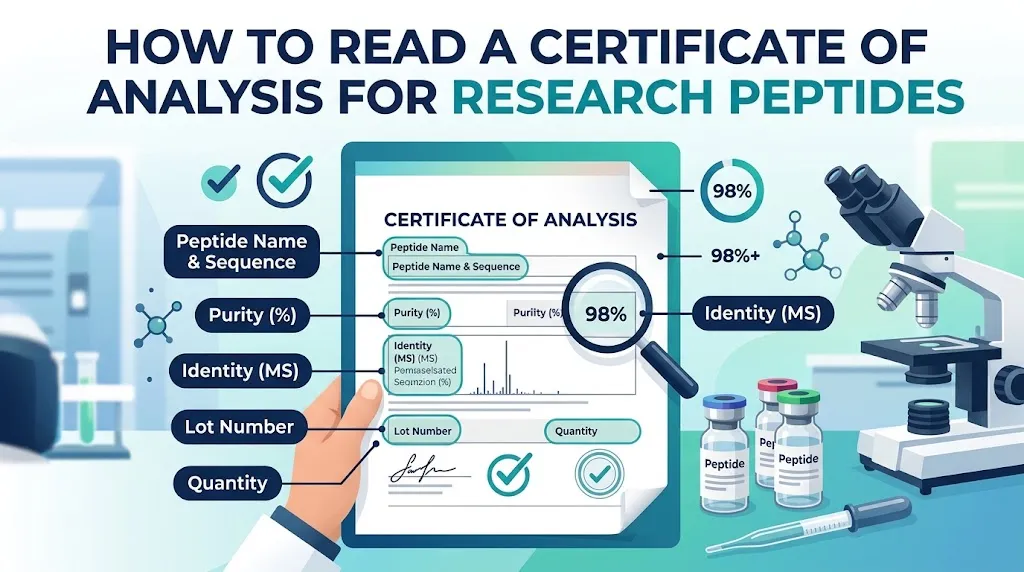

A Certificate of Analysis (COA) is an important document used to communicate analytical findings about a particular research material. It helps laboratory personnel understand what was tested, which analytical methods were used, and what results were reported for the identified sample.
For research peptide materials, a COA may contain information about sample identification, batch references, HPLC analysis, assay results, and other analytical tests.
However, reading a COA requires more than looking at a single purity percentage. Researchers should understand the meaning and limitations of each reported result before drawing conclusions.
Suppliers such as Remy Research provide product information and selected laboratory documentation for research-use-only materials.
This guide explains the main sections of a peptide COA and provides a practical framework for interpreting its contents.
1. What Is a Certificate of Analysis?
A Certificate of Analysis is a document that records analytical results for an identified sample or batch.

It may be issued by a testing laboratory, manufacturer, or another responsible organization, depending on the testing arrangement.
For research peptide materials, a COA may include:
- Product or sample name.
- Batch or lot identification.
- Sample reference number.
- Testing laboratory.
- Analytical methods.
- Testing date.
- Reported analytical findings.
- Relevant method notes or limitations.
The exact contents vary between laboratories and testing procedures.
A COA should be treated as a record of the tests actually performed. It should not be assumed to confirm characteristics that were not included in the analytical work.
2. Check the Product and Sample Identification
The first step when reviewing a COA is to establish exactly which sample the report describes.
Researchers should look for the following details:
Product Name: The document should identify the material submitted for testing.
Sample Reference: A laboratory may assign a unique reference number to the submitted sample.
Batch or Lot Number: This helps connect the report with a particular production or supply batch, where such information is provided.
Sample Format: The report may identify whether the tested material was supplied in a vial, pen, or another format.
Manufacturer or Client Information: These details may help establish the context of the analytical request.
If product or sample identification is unclear, researchers should request clarification rather than assuming that the report applies to a particular product.
3. Understanding HPLC Analysis
High-Performance Liquid Chromatography (HPLC) is an analytical technique used to separate components within a sample.
In peptide analysis, HPLC can produce a chromatogram containing peaks that represent detected components under the specified analytical conditions.
A typical HPLC report may include:
- Chromatogram.
- Retention times.
- Peak areas.
- Peak integration information.
- Detector information.
- Calculated purity percentage.
The chromatogram provides a visual representation of detector response over the analytical run.
Researchers should examine the chromatogram and associated method information rather than relying exclusively on the final percentage shown in the report.
4. What Does HPLC Purity Percentage Mean?
HPLC purity is often reported as a percentage calculated from integrated chromatographic peak areas.
In a typical area-normalisation approach, the area assigned to the target peak is compared with the combined area of the integrated peaks included in the calculation.
The result is method-dependent.
For example, a report showing 99% HPLC area purity generally indicates that approximately 99% of the included integrated chromatographic signal was assigned to the target peak under that particular method.
It does not automatically mean that 99% of the total physical sample weight consists of the target peptide.
This distinction matters because detector response can vary between compounds, and some substances may not be detected or quantified equally under a particular analytical method.
Researchers should therefore review:
- The calculation approach.
- Detector type.
- Detection wavelength, where applicable.
- Peak integration parameters.
- Method conditions.
- Any exclusions or reporting notes.
A purity percentage should always be interpreted within the context of the method used to produce it.
5. Understanding the HPLC Chromatogram
The chromatogram is one of the most informative parts of an HPLC report.
It normally displays detector response against retention time.
Researchers reviewing a chromatogram may examine:
Retention Time
Retention time indicates when a detected component appears during the chromatographic run.
Peak Area
Peak area represents the integrated detector response assigned to a particular peak.
Peak Shape
Peak shape can provide information about chromatographic separation and the appearance of the detected signal.
Peak Integration
Integration determines how the instrument or analyst identifies and calculates the area of individual peaks.
Unidentified Peaks
Additional peaks may require further investigation. Their presence or absence should be interpreted according to the method and its detection capabilities.
A chromatogram should not be interpreted in isolation. The analytical method and laboratory notes are necessary for understanding what the displayed data actually represent.
6. Purity and Assay Are Different Measurements
One common misunderstanding is treating HPLC purity and assay as interchangeable measurements.
They are related analytical concepts, but they answer different questions.
HPLC Purity
This may describe the relative proportion of the target peak within the integrated chromatographic signal.
Assay or Content
An assay aims to quantify the amount or concentration of a specified substance using an appropriate analytical procedure and calibration approach.
For example, an assay may be reported in milligrams, milligrams per millilitre, or as a percentage, depending on the method.
A sample can have a high reported HPLC area purity without that percentage establishing its total content by weight.
Researchers should therefore look for separate purity and assay results when both measurements are relevant to the analytical review.
7. Review the Analytical Method and Testing Conditions
A COA should provide enough method information to understand how the reported results were generated.
Depending on the report, relevant details may include:
- Analytical technique.
- Column information.
- Mobile phase.
- Detection wavelength.
- Run conditions.
- Reference standards.
- Sample preparation.
- Calculation method.
Not every report will disclose every method parameter. Where important details are missing, researchers should identify the limitation.
Two HPLC reports should not automatically be considered directly comparable simply because both display a purity percentage.
Differences in analytical conditions, detector response, integration procedures, and reporting conventions can influence the results.
8. Check Whether Identity Testing Is Included
A purity result and an identity result are not necessarily the same thing.
HPLC can provide chromatographic information that may contribute to an identity assessment when appropriate reference materials and methods are used.
Mass spectrometry, including LC-MS, can provide additional information about the mass characteristics of detected compounds.
However, the exact strength of the evidence depends on the analytical procedure and the information reported.
When reviewing a COA, researchers should check whether identity testing was actually performed and whether the report explains the method and findings.
A document that only reports HPLC purity should not automatically be described as providing complete molecular identity confirmation.
9. Review the Testing Laboratory and Report Date
The issuing laboratory is another important part of a COA.
Researchers should check whether the document clearly identifies the laboratory responsible for the analysis.
Relevant information may include:
- Laboratory name.
- Report number.
- Testing date.
- Sample reference.
- Analytical methods.
- Laboratory contact or verification information, where provided.
The testing date helps establish when the identified sample was examined.
It does not automatically establish the condition or analytical characteristics of materials supplied at a later date.
Similarly, a report should not be treated as current batch evidence unless its sample identification and batch relationship support that conclusion.
10. Match the COA to the Correct Batch
Batch matching is essential when using laboratory reports as supporting documentation.
A supplier may publish a COA for a tested sample while listing other product formats or strengths under the same compound name.
Researchers should establish whether the report describes:
- The exact product format being reviewed.
- A different strength or presentation.
- A sample mapped to another product listing.
- A historical batch rather than current inventory.
If a report describes a different sample or format, the relationship should be clearly documented.
For example, supplier-provided mapping between a tested sample and another product listing should not be presented as direct testing of that second format.
The report should always be interpreted according to its actual sample identification.
11. A Practical COA Review Checklist
The following checklist can help laboratory personnel review a Certificate of Analysis systematically.
| COA Section | What to Check |
| Product identification | Is the sample clearly named? |
| Batch reference | Is a batch or sample code provided? |
| Laboratory details | Is the issuing laboratory identifiable? |
| Testing date | Is the date of analysis available? |
| HPLC method | Are relevant analytical details provided? |
| Chromatogram | Are peaks and integration information visible? |
| Purity result | Is the calculation method understood? |
| Assay result | Is content reported separately where applicable? |
| Identity testing | Is an identity-related method documented? |
| Report limitations | Are exclusions or qualifications explained? |
| Sample matching | Does the report correspond to the material being reviewed? |
Researchers looking for examples of published Peptide Lab Reports can review the available sample and batch documentation, while keeping in mind that each report applies to the specific sample identified in that document.
Conclusion
A Certificate of Analysis is a useful document for understanding the analytical information available for a research peptide sample.
For UAE laboratories, reviewing a COA involves more than checking a purity percentage. Researchers should examine sample identification, batch references, analytical methods, chromatograms, assay information, and the limitations of the reported findings.
The most important principle is to understand what each analytical result actually establishes.
HPLC purity, assay, identity testing, and batch traceability provide different types of information. They should be interpreted separately rather than treated as interchangeable evidence.
A consistent COA review process can help research organizations maintain clearer documentation and make more informed assessments of laboratory materials.
Research Use Only: Materials discussed in this article are intended strictly for in-vitro laboratory research only. They are not intended for human or veterinary use. Nothing in this article constitutes medical advice, diagnosis, treatment, or a recommendation for human or veterinary application.